Can dogs eat soup and broth, and what is actually in the stock
Broth sounds like the gentlest thing you could give a dog. What makes it taste of anything is usually the part a dog should not have.
The short answer
- Plain, unsalted, onion-free broth is not a problem. Almost nothing sold or cooked as soup meets that description.
- Onion, garlic, leek, shallot and chive all belong to Allium and damage red blood cells. The effect is cumulative across meals, not a single-exposure event.
- Powdered and dehydrated forms are the most concentrated: a stock cube delivers far more Allium per gram than a fresh onion does.
- Salt and fat carry their own consequences — thirst and, in a rich meal, pancreatitis, which is a common post-holiday veterinary presentation.
- The damage from Allium can appear days after the meal, so a dog that seems fine that evening has not necessarily escaped.
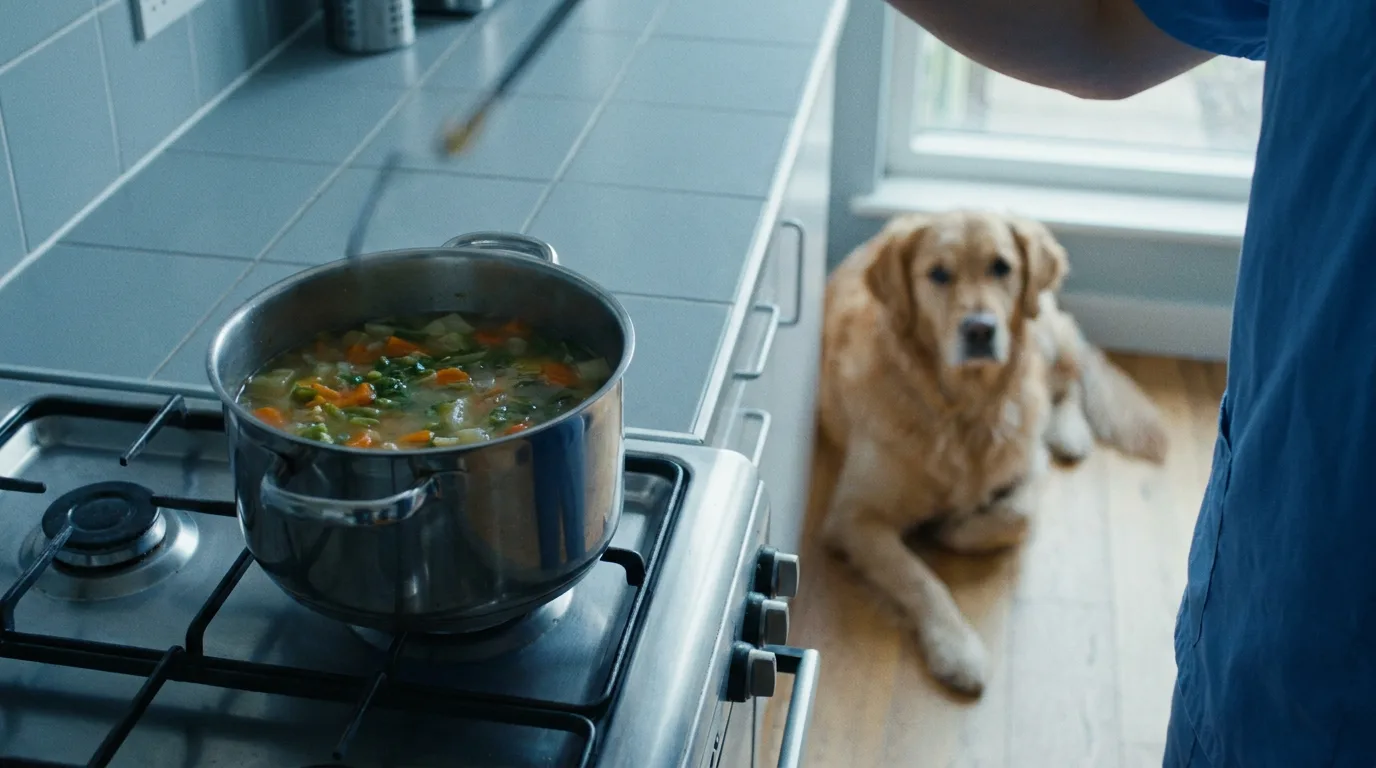
Soup gets offered to dogs for the most sympathetic reasons: a dog off its food, a cold evening, leftovers that seem too plain to do harm. And the base of it — meat, water, vegetables — genuinely is plain.
The problem is that the things which make soup taste like soup are onion, salt and fat, and each of those has a specific consequence in a dog. It is worth separating them, because they behave very differently: one is cumulative and quiet, one is immediate and noisy, and one arrives about twelve hours later.
What is actually dissolved in it
Allium: the one that hides
Onion, garlic, leek, shallot and chive all belong to the genus Allium, and they share a mechanism.
They contain organosulfur compounds which, once absorbed, oxidise the haemoglobin inside red blood cells. Oxidised haemoglobin precipitates into inclusions called Heinz bodies, the cell membrane is damaged, and the spleen removes the affected cells from circulation. The result is a haemolytic anaemia — fewer red cells, less oxygen delivery, and a dog that becomes weak and pale.
Three properties make this different from most food hazards.
Cooking does not help. The compounds survive heat, drying and processing. Onion in a stew is onion.
It is cumulative. Damage from repeated small exposures adds up. A dog given a little every day for a fortnight is at more risk than one that stole a single mouthful, which inverts most people’s intuition about “just a bit”.
The signs are delayed. Red cells are destroyed over the days following exposure, so a dog that ate onion soup on Sunday may show nothing until Tuesday or later. The evening after a meal is not the all-clear it feels like.
Cats are more susceptible than dogs to the same mechanism, so a household cat licking out the same bowl is a larger concern in a smaller animal.
Garlic sold as a "natural" flea remedy deserves a specific mention. There is no established insecticidal benefit, and there is an established effect on red blood cells, given daily, by design. If a product's selling point is that it is natural rather than that it works, the risk is real and the benefit is not.
Concentration is the trap
The most dangerous Allium in most kitchens is not in the vegetable drawer. It is powdered.
Dehydration removes water and leaves the active compounds concentrated by weight, so onion powder, garlic powder, stock cubes, bouillon powder, gravy granules and dried seasoning mixes deliver far more per gram than the fresh vegetable. A dog that finds and eats a stock cube has eaten something much more concentrated than an onion, and a small dog has eaten proportionally more still.
The same applies to the seasoning in packaged foods generally — sauces, marinades, crisps, savoury snacks. Anything whose ingredient list mentions onion or garlic in any form is on the list.
Salt and fat, briefly
Salt. Soup and commercial stock are heavily salted. A little in a diluted broth mostly means thirst; a concentrated source such as a swallowed stock cube is a different matter and can produce vomiting, unsteadiness and worse. The practical point is that “a splash of stock on the food” repeated daily is a salt load nobody counted, particularly in a dog with a heart or kidney condition where sodium is being managed deliberately.
Fat. A sudden large intake of fat is a recognised trigger for acute pancreatitis in dogs. It presents as repeated vomiting, abdominal pain — often a hunched posture or the “prayer” position with chest down and rear raised — lethargy and refusal to eat, and it is painful and potentially severe. Practices see a reliable rise in cases after holidays for exactly this reason: skimmings, gravy, cream and trimmings all arriving at once.
| Component | Mechanism | When signs appear |
|---|---|---|
| Onion, garlic and relatives | Oxidative damage to red blood cells; cumulative | Days later — the delay is the danger |
| Salt | Sodium load; severe if concentrated | Hours |
| Fat | Trigger for acute pancreatitis | Within a day or so |
| Cooked bones in the stock | Sharp fragments, obstruction | Hours to days |
That last row is easily forgotten: a stock made from a carcass may still contain bone fragments, and the reasoning about them is in can dogs eat chicken bones.
What is genuinely fine
None of this argues against broth as such.
Plain broth — meat or bones simmered in water with no salt, no onion, no garlic and the fat skimmed off — is unproblematic, and a little of it stirred into food or water is a reasonable way to encourage a convalescent or dehydrated dog to take fluid. Commercial broths marketed for dogs exist for this purpose; the ingredient list is still worth reading, because “natural flavouring” covers a good deal.
Plain cooked vegetables such as carrot, green beans, pumpkin and plain potato are fine for most dogs in modest amounts, with the usual caveat that any unfamiliar food in quantity can upset a stomach.
What to skip: anything from a packet, anything you seasoned for yourself, restaurant leftovers, and any broth whose ingredients you cannot name.
If a dog has already had some
A lick of seasoned soup. Note it, watch over the following days rather than the following hour, and mention it if anything changes.
A meaningful amount of onion or garlic, or a swallowed stock cube. Telephone a practice or an animal poison service at the time. Say what it was, roughly how much, when, and the dog’s weight. Do not wait for signs — the delay is a feature of the mechanism, not evidence that nothing happened.
Signs to report: lethargy and weakness; pale or yellow-tinged gums; faster breathing or an obviously rapid heart rate; red or brown urine; vomiting or diarrhoea; and, for a fatty meal, repeated vomiting with a hunched, painful posture. The wider framework for judging urgency is in early signs of illness in cats and dogs.
Bottom line
Plain unsalted broth with no onion or garlic is fine for a dog and is a reasonable way to get fluid into one that is off its food. Household soup and commercial stock rarely qualify: onion, garlic, leek, shallot and chive all damage red blood cells through oxidative injury, cooking does not destroy the compounds, the effect accumulates across meals, and the signs appear days later rather than the same evening. Dried and powdered forms — stock cubes, gravy granules, seasoning mixes — are the most concentrated source in the kitchen. Salt drives thirst and is dangerous concentrated; a sudden fat load is a recognised trigger for pancreatitis. If a dog has eaten a meaningful amount, call at the time rather than waiting to see, because by the time it looks unwell the red cells have already gone.
Questions readers ask
Can dogs eat soup or broth?
Plain broth with no salt, no onion, no garlic and no added fat is harmless and is sometimes used to encourage drinking in a convalescent dog. Ordinary household soup and commercial stock are a different matter: they usually contain onion or garlic in some form, a substantial amount of salt, and often enough fat to matter. The question is not really about soup as a category — it is about what has been dissolved into it.
Why are onion and garlic a problem for dogs?
Allium species contain organosulfur compounds that, once absorbed, oxidise the haemoglobin inside red blood cells. The damaged haemoglobin precipitates into Heinz bodies, and the cells are removed from circulation, producing a haemolytic anaemia. Dogs and cats are far more susceptible to this than people, cats more than dogs. Cooking does not destroy the compounds, so onion in soup is as relevant as onion raw.
Is garlic really dangerous, or is that a myth?
Garlic is in the same genus and works by the same mechanism; the difference from onion is a matter of degree, not of kind. It is sometimes promoted as a natural flea remedy, which has no established effect on fleas and does have an established effect on red blood cells. Because the damage is cumulative, a small amount given deliberately every day is a more reliable way to cause harm than a single accidental mouthful.
What makes a stock cube worse than an onion?
Concentration. Dehydrated and powdered Allium contains far more of the active compounds per gram than the fresh vegetable, because the water has been removed. A stock cube or bouillon powder therefore delivers a meaningful dose in a very small volume, and it is also heavily salted. The same applies to onion and garlic powder in gravy granules, seasoning mixes and many packaged sauces.
What are the signs if a dog has eaten onion or garlic?
They are typically delayed by a day or several, which is what catches people out. Look for lethargy and weakness, reduced appetite, pale or yellow-tinged gums, faster breathing or heart rate, red or brown discolouration of the urine, and vomiting or diarrhoea earlier on. If a dog has eaten a meaningful amount of Allium, telephone a practice at the time rather than waiting to see whether signs appear.
Is fatty food really a risk, or just a rich meal?
A sudden large intake of fat is one of the recognised triggers for acute pancreatitis in dogs, and practices see a predictable rise in cases after holidays for exactly that reason. Signs are repeated vomiting, abdominal pain — often shown as a hunched back or a prayer position — lethargy and refusal to eat. It is painful, it can be severe, and it is not resolved by waiting.
Sources
- Animal Poison Control Center — ASPCA
- Pet Poison Helpline — Pet Poison Helpline
- Household hazards — American Veterinary Medical Association (AVMA)
- Dog owners — veterinary manual — MSD/Merck Veterinary Manual
- Global nutrition guidelines — World Small Animal Veterinary Association (WSAVA)
Galen publishes reference material on veterinary medicines. It describes how products are labelled, stored and classified; it does not tell you what to give an animal, in what amount, or for how long. Those decisions belong to a veterinarian who has examined the animal, working from the manufacturer's labelling for the exact product in front of them. Where national rules apply — to prescribing, residues in food, or reporting a suspected reaction — the authority in your own country is the one that governs.