Intestinal obstruction in dogs: what it is and which signs cannot wait
A dog with a blockage and a dog with a stomach upset look similar for the first few hours. After that they diverge sharply, and only one of them is still improving.
The short answer
- Repeated vomiting with no faeces passing, a dog that will not settle, and a painful abdomen is the pattern that separates an obstruction from a stomach upset.
- A linear foreign body — string, thread, tinsel, fabric — is the dangerous kind: one end anchors and the intestine gathers along it, so the gut saws through itself.
- A complete obstruction cuts the blood supply to a section of bowel. That section dies, then leaks, and the problem becomes septic peritonitis.
- Do not give food, oil, laxatives or anything to 'move it through', and do not induce vomiting — several of these make the situation materially worse.
- Vomiting that stops is not recovery when the dog is also becoming quieter. Deterioration in an obstructed dog is often silent before it is dramatic.
Dogs swallow things. Most of what they swallow passes, which is precisely why the ones that do not are so often given an extra day — and why an obstruction is one of the few conditions where the delay does more damage than the object.
The mechanism is worth understanding because it explains why the advice is so uncompromising. This is not a blockage in a pipe that will eventually shift. It is a blockage in living tissue whose blood supply depends on not being stretched.
If this is happening now: telephone a veterinary practice. Do not give food, oil, laxatives or anything to move it along, and do not induce vomiting. If a thread or string is visible in the mouth or at the anus, do not pull it — the other end may be anchored several loops of intestine away.
What an obstruction does
A foreign object lodges somewhere along the digestive tract. The intestine upstream of it keeps contracting, fluid and gas accumulate, and the bowel distends. Three things then follow, in order.
Fluid is lost. The dog vomits, and fluid also pools in the distended loops where it is no longer available to the body. Dehydration develops quickly, and electrolytes go with it. The checks are in dehydration in cats and dogs, though in this situation the vomiting itself is the more reliable signal.
The blood supply is compromised. The intestinal wall is thin and its vessels run through it. Stretched by distension, or pinched by an object pressing against it, the wall receives less blood than it needs. Tissue starved of blood dies.
The barrier fails. Dead bowel wall leaks, and the contents of the intestine — including a very large bacterial population — enter the abdominal cavity. That is septic peritonitis, and it is the reason obstruction is a time-critical diagnosis rather than an uncomfortable one.
The three shapes it takes
Partial obstruction is the one that gets missed. Liquid still passes, so there may be small amounts of watery faeces — which reads as diarrhoea rather than as a blockage. The dog vomits, seems better, eats, vomits again. The pattern over days is what gives it away.
Complete obstruction stops everything. Vomiting becomes persistent and often forceful, nothing is passed, and the dog deteriorates on a scale of hours.
Linear foreign body is the one to know about, because it is common, it comes from ordinary household objects — sewing thread, dental floss, tinsel, the string from a joint of meat, a strip torn from a soft toy or a sock — and it does the most damage per centimetre. The rule that follows from the mechanism is absolute: never pull on a thread you can see, whether it is under the tongue or emerging from the other end. You cannot know what it is attached to.
What the dog looks like
| Feature | Dietary upset | Obstruction |
|---|---|---|
| Vomiting | Settles over hours | Persists, or returns each time anything is offered |
| Faeces | Loose, but present | Absent, or small amounts of liquid squeezing past |
| Appetite | Returns, often eagerly | Absent and stays absent |
| Demeanour | Brightens between episodes | Progressively quieter, hunched, will not settle |
| Abdomen | Unremarkable to touch | Painful, tense, sometimes distended |
| Direction over a day | Improving | The same or worse |
The posture is worth recognising. A dog in abdominal pain often adopts a “prayer” position — chest and forelegs on the floor, hindquarters raised — because it relieves pressure. A dog that repeatedly lies down and gets up again, that paces at night, or that will not settle in its usual place, is telling you something even when nothing else is obvious.
Vomiting that stops is not automatically improvement. In a dog that is simultaneously becoming quieter, less responsive and less interested, it can mean the stomach has emptied and the animal has less energy to vomit. Judge by the whole picture, not by the symptom that is easiest to count.
Why the home remedies make it worse
Each of the common suggestions fails for a specific reason, and it is worth knowing them because they sound so reasonable.
Oil, butter or liquid paraffin. These lubricate a hard faecal mass in constipation. A mechanical obstruction in the small intestine is not a lubrication problem, and adding oil to a stomach that may need emptying under anaesthetic adds an aspiration risk.
Laxatives. They increase peristalsis. Increasing the force with which the bowel pushes against a fixed object is precisely the mechanism that damages the wall.
Bulk fibre or bread. Adds volume upstream of a blockage.
Inducing vomiting. Wrong for anything sharp, wrong for anything already past the stomach, and dangerous in a dog that is weak. Whether to empty the stomach is an imaging-informed decision.
“Wait and see if it passes.” Sometimes it does. The cost of being wrong is a resection of dead bowel in a septic dog, and nothing available at home distinguishes the two cases.
What happens at the practice
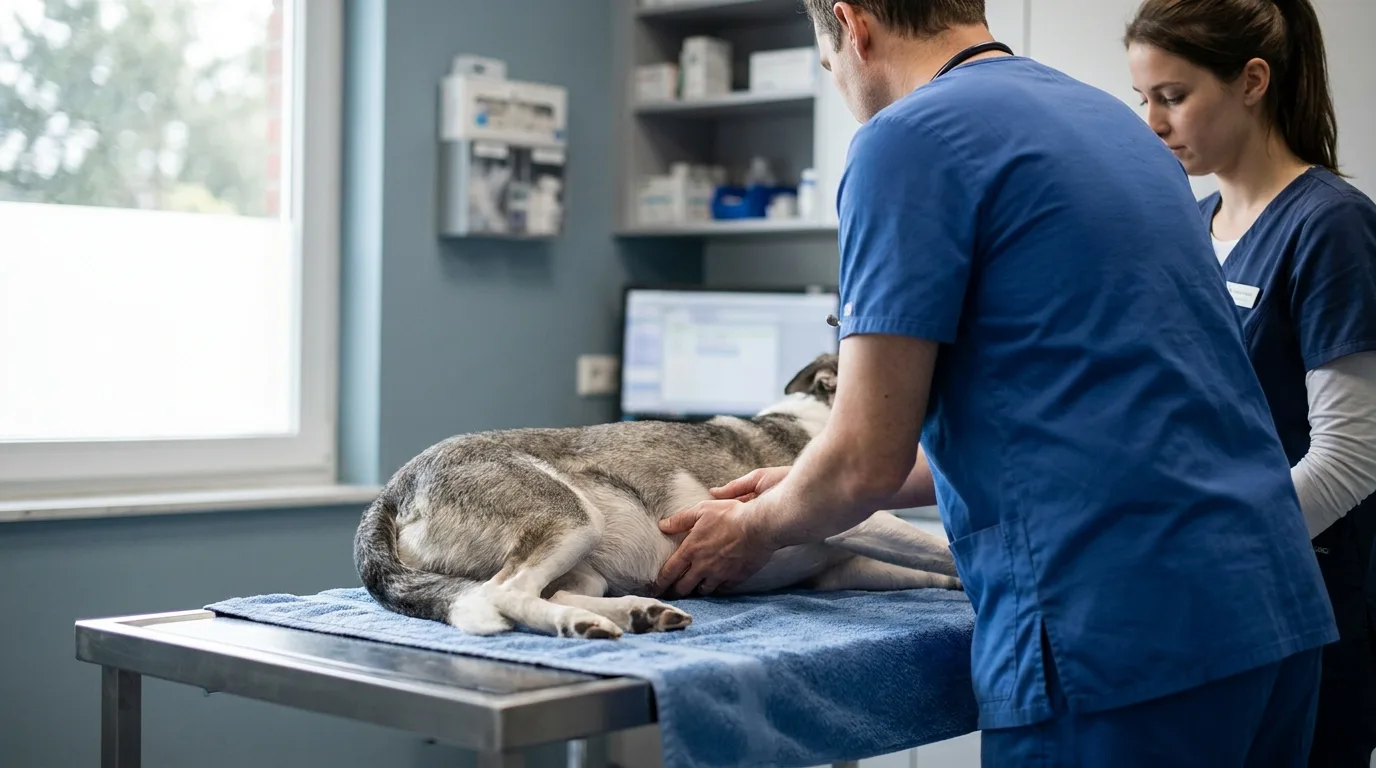
Examination and careful abdominal palpation first — an experienced clinician can sometimes feel a foreign body or a gathered loop of intestine. Then imaging: radiographs, which show gas patterns and radiopaque objects and often the distinctive gathered “bunching” of a linear foreign body; sometimes contrast studies; and ultrasound, which sees fluid-filled loops, wall thickening and objects that do not show on a plain film. Blood tests assess hydration, electrolytes and organ function before any anaesthetic.
What follows depends on where the object is and what it has already done. An object still in the stomach or oesophagus can sometimes be retrieved with an endoscope. Beyond that it is surgery — an enterotomy to remove it, or a resection and anastomosis where a section of bowel is no longer viable. Fluid therapy and analgesia run throughout.
The reason to arrive early is visible in that list. The same object is a sedation and a scope on the first evening, and an abdominal surgery on a dehydrated septic dog two days later.
Reducing the odds
Most obstructions are preventable, and the prevention is mundane: keep sewing kits, floss, hair ties, tinsel, corn cobs, stone fruit and children’s small toys out of reach; replace soft toys once the stuffing is exposed; supervise chews and remove them once they are small enough to swallow; and secure bins.
A dog that repeatedly eats non-food objects is doing something worth investigating rather than scolding — boredom, anxiety, insufficient chewing outlet, and in some cases a medical cause of appetite disturbance all produce the behaviour. That is the subject of why dogs chew furniture, and it is the durable version of prevention.
Bottom line
An intestinal obstruction stops material moving, distends the bowel upstream, compromises the blood supply to the wall, and ends in dead tissue leaking intestinal contents into the abdomen. The pattern that distinguishes it from a dietary upset is repeated vomiting with no faeces passing, no appetite, abdominal pain, a dog that will not settle, and — above all — a picture that is not improving over twelve to twenty-four hours. Linear foreign bodies are the most dangerous form because the intestine gathers along an anchored string that cuts into the wall at every fold; never pull on a visible thread. Give no food, no oil, no laxatives, and do not induce vomiting. The same object is a scope on the first evening and a bowel resection on the third.
Questions readers ask
What are the signs of an intestinal obstruction in a dog?
Repeated vomiting, often persisting or worsening; complete loss of appetite; little or no faeces, or small amounts of liquid faeces squeezing past; abdominal pain shown as a hunched back, a prayer position with the chest down and rear up, restlessness or an unwillingness to lie down; lethargy that deepens; and dehydration. A partial obstruction can produce intermittent vomiting over days and a dog that seems to improve between episodes, which is why the history matters as much as the examination.
How is this different from an ordinary stomach upset?
In the first hours it may not be. What separates them is the trajectory. A dietary upset improves: the vomiting settles, the dog drinks, faeces reappear. An obstruction does not improve — vomiting continues or returns, nothing passes, and the dog becomes quieter rather than brighter. Any dog that vomits repeatedly and passes no faeces for a day, or that vomits and is also painful, belongs in a practice rather than under observation.
Why is string or thread the most dangerous thing a dog can swallow?
Because it does not travel as a lump. One end catches — commonly at the base of the tongue or at the stomach outflow — while the intestine keeps trying to push the rest along. Unable to move the anchored end, the bowel gathers itself up along the string like fabric on a thread, and the taut line saws into the inner wall at the folds. This can perforate the intestine in several places at once. Never pull on a thread visible in the mouth or at the anus: it may be anchored deep inside.
Can an obstruction resolve on its own?
Small, smooth objects sometimes pass, and partial obstructions can occasionally clear. That possibility is what makes the situation dangerous, because it encourages waiting, and waiting is what turns a straightforward retrieval into bowel surgery. Whether an object may be given time is a decision made on imaging and examination, not on hope — and it is monitored rather than left.
What should I not do while arranging a visit?
Do not give food. Do not give oil, butter, laxatives, bulk fibre or anything intended to 'help it through' — these add volume to a stomach that may need emptying, they do not lubricate a mechanical blockage, and they delay assessment. Do not induce vomiting, which can force a sharp object back through the oesophagus. Do not press or massage the abdomen. Water may be offered in small amounts unless advised otherwise, but expect it to come back up.
What happens at the practice?
An examination and abdominal palpation, then imaging — radiographs, sometimes with contrast, and ultrasound, which shows fluid-filled loops and can identify a linear foreign body. Blood tests assess hydration and electrolytes. Depending on what is found, the object may be retrievable by endoscopy if it is still in the stomach or oesophagus, or surgery may be needed to remove it and, where the bowel has been damaged, to resect the affected section. Fluid therapy and pain relief run alongside all of it.
Sources
- Dog owners — veterinary manual — MSD/Merck Veterinary Manual
- The Merck Veterinary Manual — MSD/Merck Veterinary Manual
- Pet first aid tips — American Veterinary Medical Association (AVMA)
- Household hazards — American Veterinary Medical Association (AVMA)
- Global guidelines for small animal practice — World Small Animal Veterinary Association (WSAVA)
Galen publishes reference material on veterinary medicines. It describes how products are labelled, stored and classified; it does not tell you what to give an animal, in what amount, or for how long. Those decisions belong to a veterinarian who has examined the animal, working from the manufacturer's labelling for the exact product in front of them. Where national rules apply — to prescribing, residues in food, or reporting a suspected reaction — the authority in your own country is the one that governs.