Can I give my dog human painkillers: paracetamol, ibuprofen and aspirin
A dog in pain and a packet on the shelf is the most sympathetic reason people reach for a human medicine. It is also how a painful evening becomes a hospital stay.
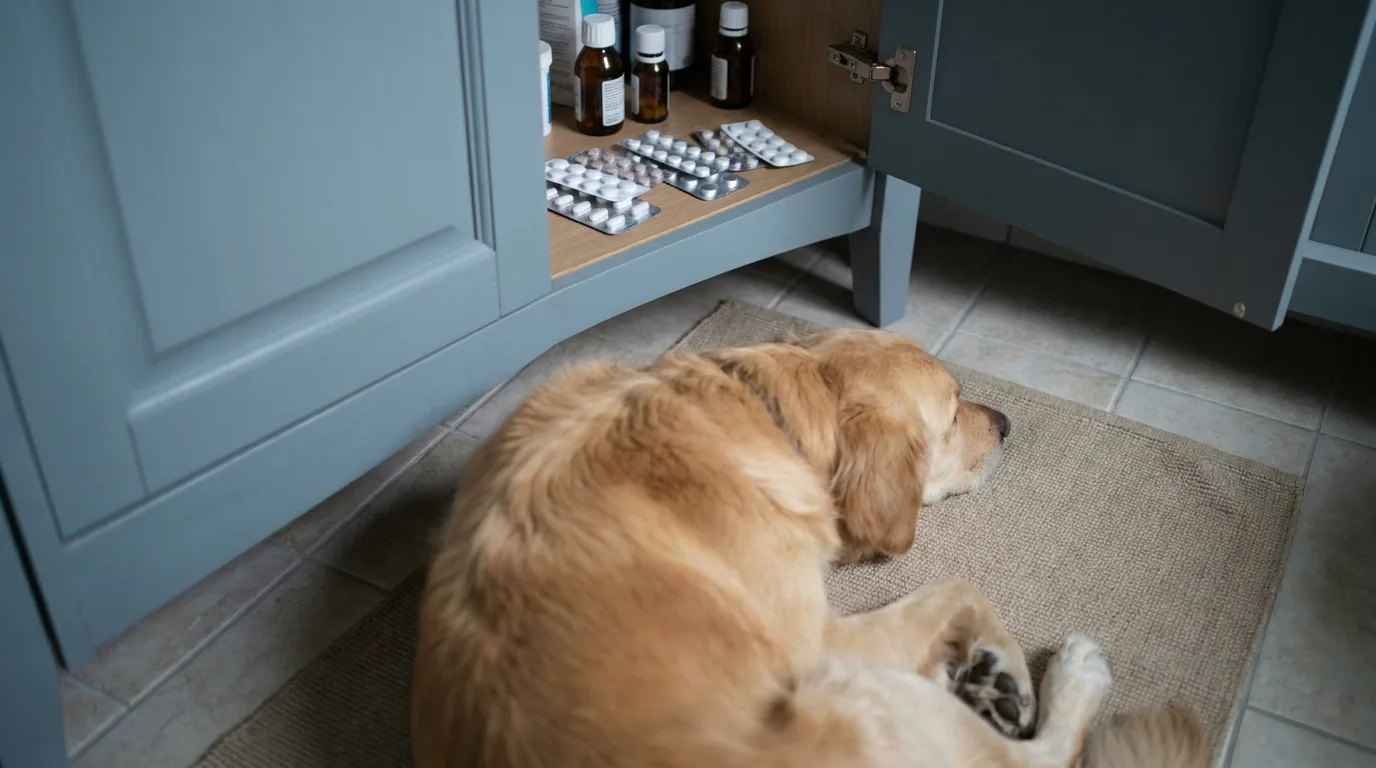
The short answer
- Paracetamol, ibuprofen, naproxen and aspirin each damage a different organ system in dogs, and each has a margin far narrower than the one people assume from human experience.
- Naproxen is the worst of them in dogs because it is cleared slowly and recirculates, so a single tablet keeps working long after a person would have finished with it.
- Ibuprofen's targets are the stomach lining and the kidney, and the gastrointestinal damage can be well advanced before anything is visible from outside.
- Veterinary NSAIDs exist precisely because the human ones do not scale down. They are authorised for dogs, dosed for dogs, and prescribed after the kidneys and liver have been considered.
- If a dog has already had a human painkiller, the useful facts are the name, the strength, how many, when, and the dog's weight — and the call comes before any home remedy.
There is a version of this question that comes from carelessness and a version that comes from care. The second is much more common: a dog is limping on a Sunday evening, the practice is shut, and there is a packet of something in a drawer that would sort out a person in twenty minutes.
The answer is still no, and it is worth understanding why rather than being told. Each of the three drugs involved fails in its own way, and the reasons are specific enough to be memorable.
If a tablet has already been given or found missing, telephone a veterinary practice or an animal poison service now, with the packet in your hand. This page explains the mechanisms; it does not manage an overdose, and the interventions that are simple are all early ones.
Three drugs, three organs
Paracetamol, in a dog rather than a cat
Paracetamol is best known as a feline catastrophe, and cats are indeed far more vulnerable — the limited glucuronidation described in human medicines and pets is why. Dogs are not exempt; they are less sensitive, which is a different statement from safe.
In a dog, the liver is the principal target. Paracetamol is conjugated and excreted, but when the conjugation pathways are saturated a reactive metabolite accumulates and binds to liver proteins, killing hepatocytes. At higher exposures dogs also develop methaemoglobinaemia — haemoglobin altered so that it cannot carry oxygen — which shows as brown-tinged mucous membranes and laboured breathing.
The clinical trap is timing. Vomiting and lethargy may appear early and then settle, and liver injury develops over the following day or two. A dog that “seemed to get over it” is exactly the case that arrives late.
Ibuprofen and naproxen
These are the drugs behind most human-NSAID cases in dogs, and both work by inhibiting cyclo-oxygenase. That enzyme does two jobs: it produces the prostaglandins involved in inflammation and pain, and it produces the prostaglandins that maintain the gastric mucosal barrier and support renal blood flow. Human NSAIDs inhibit both without much discrimination in a dog.
The consequences follow directly. Gastric and duodenal ulceration, which can progress to perforation, and which may be well advanced before anything is visible: the first outward sign is often vomiting, sometimes with blood, or black tarry faeces from digested blood higher up. Acute kidney injury, particularly in a dog that is already dehydrated, elderly, or on other medication — the same dog for whom the safety margin was already thinnest.
Naproxen deserves its own warning. Dogs clear it slowly and it undergoes enterohepatic recirculation — excreted in bile, reabsorbed from the intestine, and presented to the liver again. A tablet that is a half-day drug in a person is a multi-day exposure in a dog, which is why single-tablet ingestions of naproxen are treated more seriously than the equivalent in ibuprofen.
Aspirin
Aspirin has a longer veterinary history than the other two, and that history is the source of most of the confusion: people remember that vets used to use it and conclude it must be broadly safe.
It irritates the gastric mucosa directly as well as through prostaglandin inhibition, and it inhibits platelet function irreversibly for the lifespan of the platelet. The second effect matters more than it sounds: it is relevant if the dog needs surgery in the following days, if there is bleeding anywhere, and if a licensed anti-inflammatory is about to be started — most cannot be given straight after aspirin, so an owner’s well-meant dose can delay the treatment that would actually have worked.
| Drug | Main mechanism of harm | The particular trap |
|---|---|---|
| Paracetamol / acetaminophen | Reactive metabolite injures the liver; methaemoglobin at higher exposure | Early signs settle while liver injury continues |
| Ibuprofen | Gastric ulceration and reduced renal blood flow | Ulceration is silent until it bleeds |
| Naproxen | As ibuprofen, but sustained | Slow clearance and recirculation stretch one tablet over days |
| Aspirin | Direct mucosal irritation plus irreversible platelet inhibition | Its veterinary history reads as an endorsement |
Why “just a small amount” does not rescue any of them
Two separate failures of reasoning sit behind the weight calculation, and both are worth naming.
The first is that weight is one input among several. It says nothing about the state of the kidneys and liver on the day, about the dog’s genetics, about what else it has received, or about the concentration in this particular product — which is why reading the units on a package is a prerequisite to any calculation and not a detail.
The second is more fundamental: for some of these drugs the harm is not proportionate to the dose in the way the calculation assumes. A smaller amount of a drug that suppresses the prostaglandins protecting the gastric lining still suppresses them. It buys time; it does not buy safety. A dog given a “small” NSAID dose daily for a week is not safer than one given a single larger dose — in the gut, it may be considerably worse off.
What is actually available
The reason veterinary anti-inflammatories exist is precisely that human ones do not scale down. They are formulated at strengths that suit dogs, supplied with a measuring device that matches those volumes, authorised on studies conducted in dogs, and dispensed after the dog’s history has been considered — including its kidney and liver function, its age, and whatever else it is taking.
Beyond drugs, chronic pain in dogs is managed with weight reduction, controlled exercise, physical therapy, environmental changes and joint support, and these do a large amount of the work in the commonest cause of limping in older dogs.
There is also a diagnostic argument for not medicating at home. Pain is a symptom. A dog that stops limping because it was given something is a dog whose limp was masked, and whichever problem produced it — a cruciate injury, a fracture, an immune-mediated joint disease, something in a paw — continues while looking better. The information the limp was providing is what a veterinarian needs.
If it has already happened
- Telephone now, before signs appear. Practices and poison services expect this call.
- Have the packet. Active substance, strength per tablet, how many are gone, when, and the dog’s weight.
- Do not induce vomiting on your own initiative, and give nothing by mouth.
- Say if the dog is on anything else, including supplements and any recent veterinary medication — interactions change the plan.
- Watch for, and write down: vomiting, especially with blood; black tarry faeces; refusal of food; increased or reduced drinking and urination; pale or brown-tinged gums; lethargy; abdominal pain shown as a hunched posture.
Bottom line
Human painkillers are not scaled-down veterinary ones. In dogs, paracetamol injures the liver through a reactive metabolite and can alter haemoglobin; ibuprofen and naproxen ulcerate the stomach and reduce renal blood flow, with naproxen sustained over days by slow clearance and enterohepatic recirculation; aspirin irritates the gastric lining and disables platelets for their lifetime. Body weight cannot make any of them appropriate, because part of the harm is mechanistic rather than proportionate. Veterinary anti-inflammatories exist for dogs and are prescribed after the animal’s organs and other medication have been considered — and pain that is masked at home is pain whose cause is still there. If a tablet has already been taken, phone with the packet in hand, note the time and the weight, and give nothing else by mouth.
Questions readers ask
Can I give my dog paracetamol or ibuprofen for pain?
Not on your own judgement. Paracetamol in dogs is a liver problem and, at higher exposures, damages haemoglobin; ibuprofen and naproxen cause gastrointestinal ulceration and acute kidney injury at quantities that are unremarkable for a person; aspirin causes gastrointestinal bleeding and interferes with clotting. There are veterinary anti-inflammatories authorised for dogs and prescribed after the animal's kidney and liver function has been considered, and that is the route to pain relief that does not create a second problem.
Why is naproxen singled out as especially dangerous?
Because of how long it lasts in a dog. Naproxen is cleared slowly by dogs and undergoes enterohepatic recirculation — it is excreted in bile and reabsorbed from the intestine — so the exposure from a single tablet is sustained rather than brief. What behaves as a twelve-hour drug in a person behaves as a much longer one in a dog, and the gastrointestinal and renal effects accumulate through that period.
Is aspirin safe for dogs in a low dose?
Aspirin was used in veterinary medicine historically and has largely been displaced, because its margin is narrow and better-tolerated licensed options exist. It irritates the stomach lining directly and inhibits platelet function for the life of the platelet, which matters if surgery follows or if bleeding is already present. Giving it also complicates the picture for whoever sees the dog next, since another anti-inflammatory usually cannot be started immediately afterwards.
Can I work out a dose from my dog's weight?
No. Weight carries no information about the enzymes available to clear the drug, the state of the kidneys and liver on the day, what else the dog has been given, or the concentration in this particular product. For some of these drugs the problem is not the size of the dose at all but the mechanism — a smaller amount of a drug that damages the gastric mucosa still damages it, just more slowly.
What should I do if my dog has already taken one?
Telephone a veterinary practice or an animal poison service immediately, and do it before symptoms appear rather than after. Have the packet in hand: the active substance, the strength per tablet, how many are missing, roughly when, and the dog's weight are what decide what happens next. Do not induce vomiting on your own initiative and do not give milk, food or anything else by mouth until you have advice.
What can a vet give instead?
Veterinary practice has anti-inflammatories authorised for dogs, opioid analgesics for more severe pain, local techniques, and non-drug measures such as weight management, controlled exercise and physical therapy for chronic joint pain. Which of these applies depends on what is causing the pain, which is the part a home decision cannot supply — pain is a symptom, and treating it without knowing its source can mask a problem that is getting worse.
Sources
- Dog owners — veterinary manual — MSD/Merck Veterinary Manual
- Animal Poison Control Center — ASPCA
- Pet Poison Helpline — Pet Poison Helpline
- Animal health literacy — U.S. Food and Drug Administration, Center for Veterinary Medicine
- Household hazards — American Veterinary Medical Association (AVMA)
- Veterinary regulatory overview — European Medicines Agency (EMA)
Galen publishes reference material on veterinary medicines. It describes how products are labelled, stored and classified; it does not tell you what to give an animal, in what amount, or for how long. Those decisions belong to a veterinarian who has examined the animal, working from the manufacturer's labelling for the exact product in front of them. Where national rules apply — to prescribing, residues in food, or reporting a suspected reaction — the authority in your own country is the one that governs.