Heat stress in livestock and poultry: the temperature-humidity index and what to do
Animals lose heat by evaporation, and evaporation stops working as the air fills with moisture. That is why a humid 28 °C is harder on a herd than a dry 32 °C.
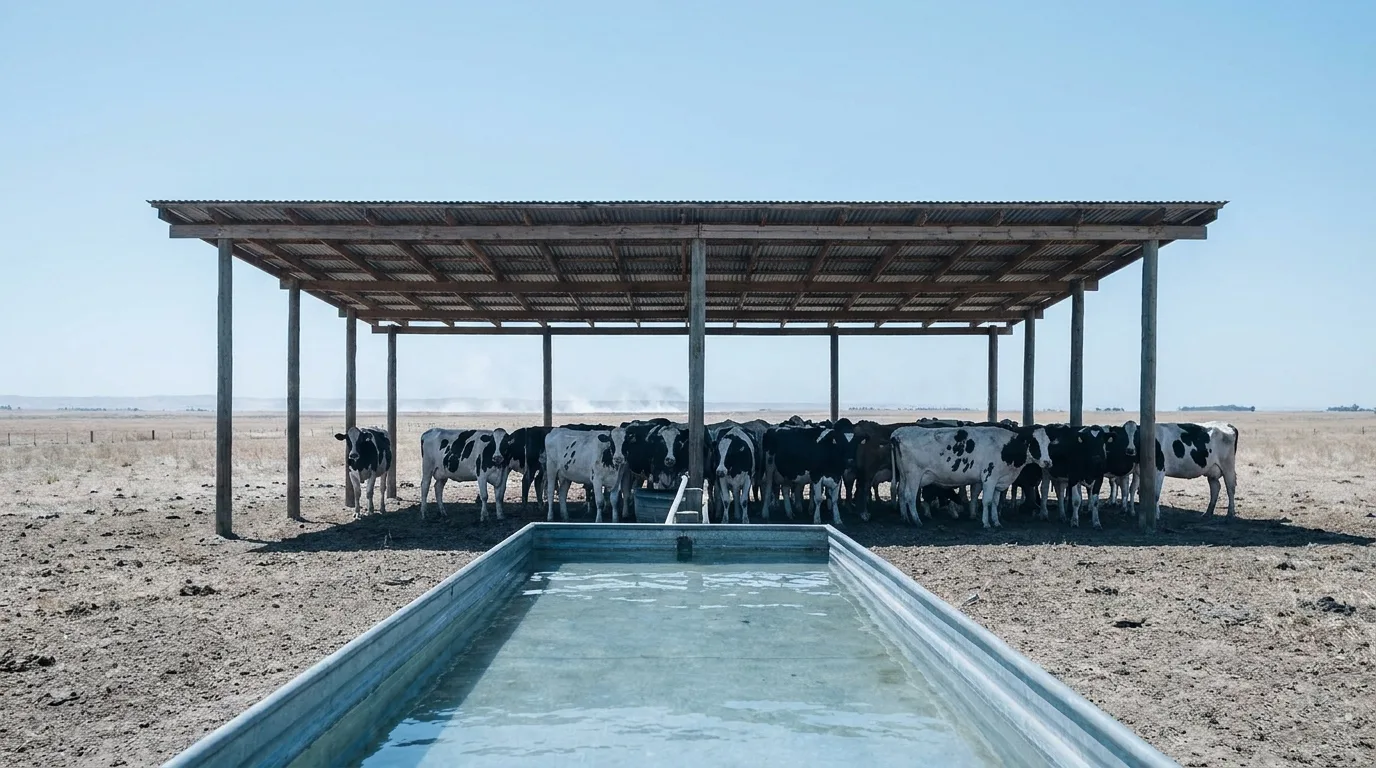
The short answer
- Heat stress begins when an animal cannot shed metabolic heat as fast as it produces it — a balance set by temperature, humidity, air speed, radiation and the animal's own heat production.
- The temperature-humidity index (THI) combines dry-bulb temperature and relative humidity into one figure; at 60% humidity, 26 °C already gives a THI of 74.
- Higher-producing animals reach the threshold sooner, because milk yield, growth and egg production are themselves large sources of internal heat.
- Water intake rises sharply in heat and is the first constraint to fail — trough capacity, flow rate and access points matter more than any additive.
- Air movement is what makes evaporative cooling work. Air speed over the animal does more than lowering shed temperature by a degree.
Every animal on a holding is a heat source. Digestion, milk synthesis, growth and muscular activity all release heat continuously, and the animal must shed that heat as fast as it makes it. Heat stress is what happens when it cannot — and the point at which it cannot is set by the air as much as by the animal.
This is why an air temperature alone is a poor guide. The same reading on a thermometer describes very different conditions depending on how much moisture the air is already carrying, how fast it is moving, and how much heat the animal in question is producing internally.
What heat stress is
Heat stress is the physiological state in which heat production exceeds heat dissipation, so core body temperature rises and the animal redirects behaviour and energy toward cooling.
Farmed mammals and birds shed heat by four routes: conduction to cooler surfaces, convection into moving air, radiation to cooler surroundings, and evaporation from skin and the respiratory tract. As air temperature approaches body temperature, the first three lose most of their effect — there is little gradient left to move heat down. Evaporation is what remains.
That single fact drives everything else in this article. Evaporation depends on the ability of the surrounding air to accept more water vapour, which is exactly what relative humidity measures. Poultry have no functional sweat glands and rely on panting; cattle and pigs sweat poorly compared with horses and depend heavily on respiratory evaporation. In humid air, all of them lose their main remaining cooling route at once.
Why humidity belongs in the measurement
The temperature-humidity index, or THI, combines dry-bulb temperature and relative humidity into a single figure. A widely used form is:
THI = 1.8 T + 32 − (0.55 − 0.0055 × RH) × (1.8 T − 26)
where T is dry-bulb temperature in °C and RH is relative humidity as a percentage.
Three cautions belong with any THI figure, and they are the reason a single “danger threshold” quoted without context is of little use.
The index has variants. Several formulations exist, weighting humidity differently, and they do not return identical numbers for the same conditions.
Thresholds differ by species and by production level. The point at which measurable effects begin is lower for a high-yielding dairy cow than for a dry cow, and lower again relative to a beef animal at maintenance, because internal heat production is part of the balance. Published thresholds for high-producing dairy cattle have moved downward over time as yields have risen.
The index ignores air speed and radiation. Two sheds at an identical THI are not equivalent if one has air moving over the animals and shade over the yard and the other does not.
What heat stress costs
The first response to heat is behavioural and it is expensive on its own: the animal eats less, because digestion generates heat. Everything downstream follows from reduced intake plus energy diverted to cooling.
| System | What is affected first | What follows if it persists |
|---|---|---|
| Dairy cattle | Feed intake, then milk yield and composition | Reduced oestrus expression, poorer conception, higher somatic cell counts |
| Beef and growing stock | Intake and daily gain | Feed conversion worsens; finishing dates slip |
| Pigs | Intake, particularly in heavier animals | Reduced growth; sows show poorer farrowing performance and lactation intake |
| Laying hens | Feed intake and egg output | Thinner shells, smaller eggs, higher breakage |
| Broilers | Intake and gain | Rising mortality in severe episodes, especially in the heaviest birds |
| Breeding males, all species | Semen quality | Effects persist for weeks after the hot period, since spermatogenesis takes time to recover |
The last row is the one most often missed, because the cause and the consequence are separated by weeks. A fertility problem in autumn can be the record of a heatwave in midsummer.
There is also an animal-health cost that shows up indirectly. Heat load suppresses immune function and coincides with a period of reduced intake, and the resulting rise in disease is one of the routine drivers of antimicrobial use on a holding — a link worth reading alongside antimicrobial resistance on the farm, where reducing predictable stress is one of the levers that actually works.
Water is the first constraint to fail
Evaporative cooling spends water, so water demand rises steeply and disproportionately in heat.
The failure is rarely supply and almost always access. What matters is whether every animal in the group can physically drink when it wants to, which depends on the number of drinking points, the space at each, the refill rate of the trough, and where the troughs are in relation to shade and feed. Groups drink in bursts — after milking, after feeding, in the late afternoon — and a system sized for average demand fails at exactly those moments.
Three practical points follow. Water temperature matters: troughs in full sun warm to a point where animals drink less of it. Cleanliness matters more in heat, because warm water fouls faster and reduced intake compounds every other problem. And in poultry, line flow rate and nipple height are the equivalent constraint, since a bird that has to work for water in heat will simply drink less.
Additives do not remove heat. Electrolyte, buffer and water-soluble vitamin preparations are used in hot periods to address specific consequences of heat stress, according to their own labelling and on veterinary advice. They are a complement to cooling, water access and shade — never a substitute. Where the cooling is inadequate, an additive changes the invoice and little else.
Air movement, shade and the physical measures
Ventilation in hot weather is not about exchanging air for its own sake. It is about moving air over the animals, because air speed at animal level is what drives convective and evaporative loss.
- Air speed where the animals are. Fans positioned to move air across lying and feeding areas do more than a system that changes shed air efficiently while leaving still air at animal height.
- Shade. Radiant load from sun on a roof or directly on animals is a large component and the cheapest to remove. Shade over feeding and drinking areas keeps intake up as well as reducing load.
- Evaporative cooling. Misting and sprinkler systems can be effective where they wet the animal’s coat and are combined with air movement — and counterproductive in already-humid conditions, or where they wet the air rather than the animal, since raising humidity in a closed space makes matters worse.
- Stocking density. Animals are heat sources standing next to each other. Reducing density in the hot season lowers the load in the space and improves access to water and shade at the same time.
- Bedding and surfaces. Deep, dry bedding insulates; a cool, clean lying surface is a conduction route that costs nothing to provide.
Adjusting the routine
Timing is one of the few levers that is entirely within a holding’s control and costs nothing.
Move feeding toward the cooler parts of the day, since the heat of digestion peaks hours after a meal and is best not landing at the hottest hour. Handle, transport, weigh and move animals early in the morning rather than in the afternoon, and postpone anything elective during a heatwave — handling adds heat production at the worst possible time. Watch the night: consecutive nights that fail to cool are what turn a hot day into a serious episode, because the animals never clear their accumulated load.
Monitoring the load
The measurements are simple and worth having on record.
Place a thermometer and hygrometer at animal height inside the building, not in an office or outdoors, and record both, since the index needs both. Track panting: open-mouth panting, drooling, extended neck and elbows held away from the body form a recognised progression of severity in cattle, and in poultry panting with raised wings is the equivalent. Watch group behaviour — crowding into shade, standing rather than lying, bunching — which is often visible before any individual looks distressed. And take rectal temperature in a few individuals when in doubt, comparing against the normal ranges by species.
Note that all of these are group measurements taken over days. A single afternoon reading tells you about that afternoon; the trend across a week is what predicts the production and fertility consequences.
Bottom line
Heat stress is the point at which an animal cannot shed heat as fast as it produces it, and humidity belongs in the measurement because evaporation is the cooling route that remains once the air is warm. The temperature-humidity index combines the two: at 28 °C, raising humidity from 20% to 80% adds eight index points, the same as adding eight degrees in dry air. Higher-producing animals reach the threshold sooner because their own metabolism is part of the load. The costs begin with reduced feed intake and run through yield, growth, egg quality and fertility, with male fertility effects persisting for weeks. Water access is the first thing to fail and the first thing to fix; air speed at animal level and shade come next; adjusting handling and feeding times is free. Additives address consequences and remove no heat at all.
Questions readers ask
What is heat stress and at what point does it start?
Heat stress is the state in which an animal cannot dissipate metabolic heat as fast as it generates it, so core temperature rises and the animal begins to divert energy and behaviour into cooling. There is no single temperature at which it starts, because the balance depends on humidity, air movement, solar radiation, coat, body condition and how much heat the animal is producing internally. A high-yielding dairy cow reaches the threshold at conditions a dry cow tolerates comfortably.
Why does humidity matter as much as temperature?
Because evaporation is the main route by which most farmed species shed heat once the air is warm — through the respiratory tract in cattle and pigs and through panting in poultry, which have no functional sweat glands. Evaporation depends on the air's capacity to take up more moisture, and humid air has little. At high humidity the principal cooling mechanism stops working, which is why a humid 28 °C is harder on a herd than a dry 32 °C.
How is the temperature-humidity index calculated?
A widely used form is THI = 1.8T + 32 − (0.55 − 0.0055 × RH) × (1.8T − 26), where T is dry-bulb temperature in degrees Celsius and RH is relative humidity as a percentage. At 26 °C and 60% humidity it gives 74. Several variants exist and thresholds differ by species and production level, so a THI figure should always be read together with the index version and the animal group it was derived for.
How does heat stress affect production?
It reduces feed intake, and it diverts energy to cooling. In dairy cattle this shows as reduced milk yield and altered composition; in growing stock as reduced daily gain and poorer feed conversion; in laying hens as lower egg production and thinner shells. Fertility falls across species — heat affects oestrus expression and early embryo survival in cattle, and semen quality in males for weeks after the hot period, because spermatogenesis takes time to recover.
Why does water demand rise so steeply in hot weather?
Because evaporative cooling consumes water, through respiratory losses and sweating where the species sweats. Intake can rise substantially above thermoneutral requirements, and the constraint that bites first is usually not supply but access: trough capacity, refill rate and the number of drinking points determine whether every animal in a group can actually drink, particularly around the times when the whole group wants to.
Do additives replace ventilation and water?
No. Electrolyte, buffer and vitamin preparations used in hot weather address specific consequences of heat stress, and they are used according to their labelling and on veterinary advice. None of them removes heat from an animal. Where cooling and water access are inadequate, an additive changes the number on the invoice and not much else.
Sources
- Animal production and health — Food and Agriculture Organization of the United Nations (FAO)
- Terrestrial Animal Health Code — World Organisation for Animal Health (WOAH)
- The Merck Veterinary Manual — MSD/Merck Veterinary Manual
- Antimicrobial resistance — monitoring and JIACRA reports — European Food Safety Authority (EFSA)
- Veterinary regulatory overview — European Medicines Agency (EMA)
Galen publishes reference material on veterinary medicines. It describes how products are labelled, stored and classified; it does not tell you what to give an animal, in what amount, or for how long. Those decisions belong to a veterinarian who has examined the animal, working from the manufacturer's labelling for the exact product in front of them. Where national rules apply — to prescribing, residues in food, or reporting a suspected reaction — the authority in your own country is the one that governs.