Caring for a dog after surgery: what the first two weeks require
The dog feels well several days before the tissue has healed. Almost every post-operative complication lives in that gap.
The short answer
- A dog's sense of how well it is recovering runs days ahead of the actual healing. Restriction is required for the tissue, not for the mood.
- Licking is the single largest cause of post-operative complications. The collar stays on continuously, including overnight and while unsupervised.
- A little redness and swelling along the incision is expected. Heat, spreading swelling, discharge, a gaping edge or a smell are not.
- Finish the whole course of any medication, and never add a human painkiller to what the practice dispensed.
- Ask before discharge what the specific restriction period is, what the wound should look like, and what number to call out of hours.
The surgery is the part everyone worries about, and it is the part performed by professionals in controlled conditions. The recovery happens at home, over two weeks, supervised by someone who has never done it before, on an animal that has no idea why it is not allowed on the sofa.
That is where the complications are, and almost all of them come from one mismatch.
The gap that causes everything
A dog’s subjective sense of recovery runs several days ahead of the actual state of the tissue. Effective pain relief and a young animal’s resilience mean that by day three or four a dog can be bright, hungry and keen to jump — while the incision is at its most fragile and orthopaedic repairs are nowhere near loaded.
Everything below follows from that picture.
The collar
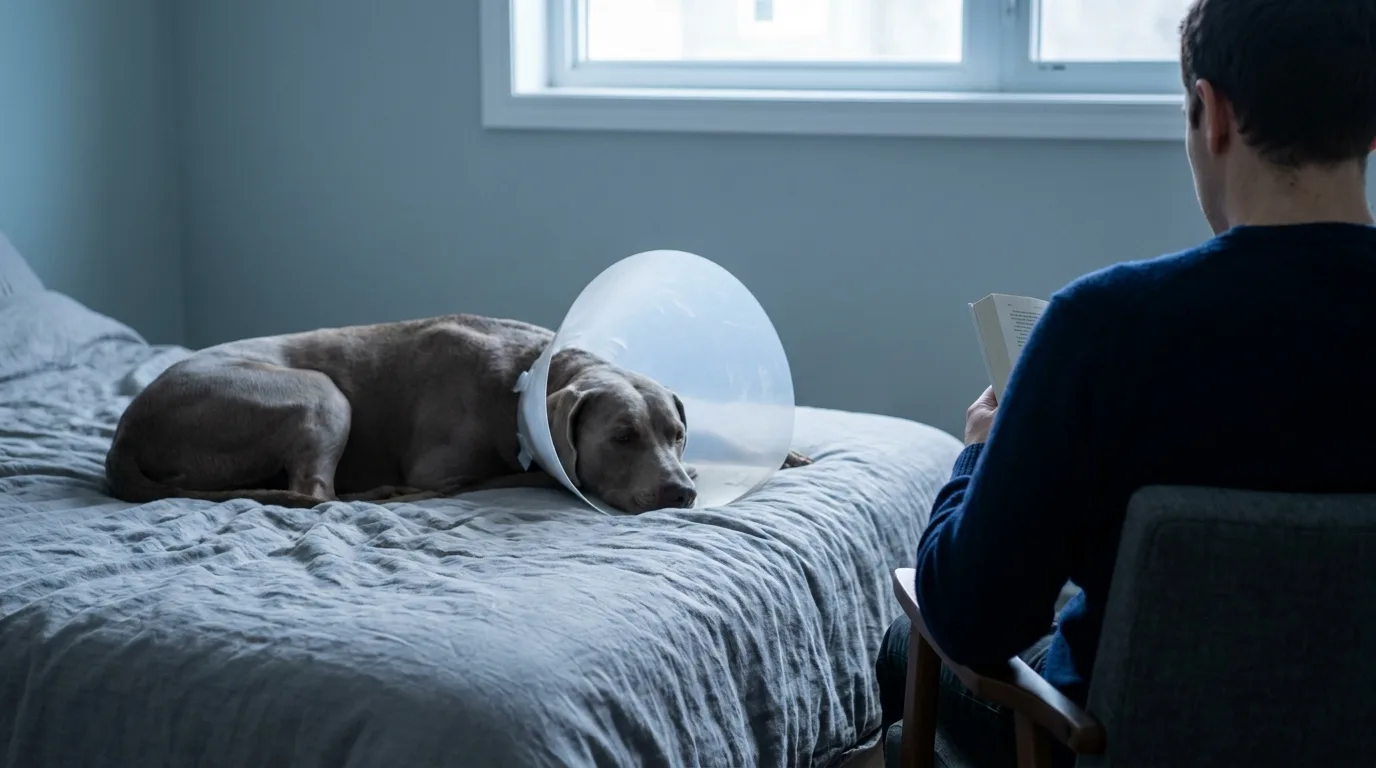
Licking is the largest single cause of post-operative problems, and the reasoning is mechanical. A dog’s tongue is abrasive, its mouth carries a substantial bacterial population, and a determined dog can remove sutures and open an incision in a couple of minutes.
The collar therefore stays on continuously — overnight, while you are out, and during the periods when the dog seems settled. Those are exactly the windows in which the damage is done, because nobody is watching.
Most dogs adapt within a day or two. Practical adjustments: raise food and water bowls so the rim of the cone does not block them, clear low obstacles the dog now bumps into, and expect a couple of days of clumsiness. If the standard cone genuinely does not work — an anxious dog, one that cannot navigate, one that panics — the answer is a different device, not no device. Inflatable collars, soft cones and surgical bodysuits all exist, and the practice can say which is appropriate for that wound’s location.
A dog that is licking is not being naughty and is not necessarily itchy from healing. Persistent attention to one spot can also mean the wound hurts, is infected, or has a suture reaction. Fitting a better collar and mentioning it at the check is the right response; assuming it is normal is not.
Watching the wound
Check it once a day, in the same light, and photograph it. A series of images shows change reliably; memory does not, and “it looks about the same” is one of the least trustworthy observations in home care.
| Finding | Expected | Call the practice |
|---|---|---|
| Redness | Mild, along the line, fading after a few days | Increasing, spreading outward, or hot to the touch |
| Swelling | Slight in the first 48 hours | Growing after day two, firm, or painful |
| Discharge | A little clear or blood-tinged fluid early on | Thick, coloured, or any smell |
| Bruising | Can appear and track downward with gravity | Spreading rapidly, or with active bleeding |
| Edges | Together, forming a thin line | Any gap, or tissue visible |
| Sutures | In place; some are dissolvable and stay under the skin | Missing, loose, or one the dog has pulled at |
Keep the wound dry. No bathing, no swimming, no wiping with antiseptic unless you were specifically told to. Wet dressings and applied products are far more likely to cause a problem than to prevent one — the reasoning is the same as in what belongs in a dog first-aid kit, where sterile saline replaces the antiseptics people reach for.
Restriction, in practice
“Keep him quiet” is the instruction most often underestimated, because it does not sound like a treatment. After orthopaedic surgery it is the treatment, and it is usually staged: a period of confinement, then short controlled lead walks, then gradual increases, each step authorised rather than assumed.
What restriction actually means:
- Lead only, including in your own garden. A dog that bolts after a cat undoes weeks.
- No jumping — on or off furniture, in or out of the car. Lift, use a ramp, or block access.
- No stairs unless you were told otherwise. Carry a small dog; use a lead and a sling for a large one.
- No play with other dogs, and no rough handling by children.
- No running, no ball, no toys that provoke sudden twisting.
- Confinement between walks — a crate, a pen or a small room. Space invites movement.
The hard part is a well dog with nothing to do. Substitute mental work for physical: food puzzles, scent games with treats hidden in a towel, short training sessions of stationary behaviours, a chew appropriate to the dog. Fifteen minutes of sniffing work tires a dog comparably to a walk, and it can be done standing still.
Medication
Give exactly what was dispensed, at the intervals stated, and finish the course even if the dog looks recovered. A course stopped early is the commonest reason an infection returns, and with antimicrobials specifically it is also a selection event — the mechanism is set out in antimicrobial resistance on the farm, and it is the same biology in a household.
Do not add anything. Human painkillers are not a top-up: paracetamol, ibuprofen, naproxen and aspirin each fail differently in dogs, and several cannot be given alongside a veterinary anti-inflammatory at all — see can I give my dog human painkillers. If the dog seems uncomfortable despite what has been given, telephone; the plan can be changed, and worsening pain is itself a finding.
If a dose is vomited back or refused, say so rather than guessing whether to repeat it.
What to expect day by day
Day 0 (the evening). Drowsy, possibly disoriented; reduced appetite is normal. Offer small amounts of bland food and free water. Keep the dog somewhere warm, quiet and level — not on furniture it might fall from.
Days 1–3. Appetite returns. Some tenderness. Swelling and redness peak early and then begin to settle. Bruising may appear.
Days 4–7. The dog feels well. This is the gap in the chart above and the point at which restriction is most often relaxed by accident.
Days 8–14. External sutures or staples are typically removed around ten to fourteen days for routine procedures. Skin strength is still well below normal at removal.
Beyond. Orthopaedic recovery continues for weeks to months in supervised stages.
What to ask before you leave the practice
Discharge happens quickly and in a car park. Five questions are worth having answered before you drive away:
- What exactly was done, and is there a written discharge sheet?
- What is the restriction period for this procedure, and what does each stage permit?
- What should the wound look like, and what would concern you?
- What medication, at what times, for how many days, and what if a dose is missed or vomited?
- What is the number outside working hours, and where do I go?
Write the answers down. Nobody remembers them accurately at home with a sedated dog and a cone.
Bottom line
Post-operative care is about closing the gap between how a dog feels and how healed it is. Keep the collar on continuously, not just when you are watching, because licking causes more complications than anything else. Check the wound daily in the same light and photograph it: mild redness and early swelling that settle are expected; heat, spreading or increasing swelling, discharge, smell or a gap are not. Restrict as instructed — lead only, no jumping, no stairs, confinement between walks — and substitute sniffing and food puzzles for exercise. Give exactly what was dispensed, finish the course, and add nothing from a human cabinet. Ask before discharge what the restriction period is, what the wound should look like, and what number to ring out of hours.
Questions readers ask
How long does a dog need to be kept quiet after an operation?
It depends entirely on what was done, and the practice will give a specific period — commonly around ten to fourteen days for a routine soft-tissue procedure, and considerably longer, often measured in weeks to months and in staged increments, after orthopaedic surgery. The important thing is that the period is set by the tissue's healing timetable rather than by how the dog appears, and it does not shorten because the dog seems fine.
Does my dog really have to wear the collar?
Yes, and continuously rather than only when you are watching. Licking is the largest single cause of post-operative complications: it introduces bacteria, removes sutures, and can open an incision in minutes. The window in which a dog does this is usually the one where nobody is present. If the standard cone is intolerable, ask the practice about alternatives — inflatable collars, soft cones, or a surgical bodysuit — rather than removing it and hoping.
What should the wound look like as it heals?
A thin line, with the edges together, mild redness along it and a little swelling in the first days, occasionally with a small amount of clear or slightly blood-tinged fluid early on. Bruising can appear and spread downward with gravity, which looks alarming and is usually not. What is not expected: heat, swelling that increases after the first couple of days, thick or coloured discharge, a smell, a gap between the edges, or exposed tissue. Photograph it daily in the same light — a series shows change far better than memory does.
My dog will not eat the evening after surgery — is that normal?
A reduced appetite on the first evening is common after a general anaesthetic, and small amounts of a bland, easily digested food usually suit better than a full meal. What is not expected is refusing food beyond about twenty-four hours, repeated vomiting, or an appetite that had returned and then disappeared again. Those are reasons to call. Water should be available and drinking should resume normally.
Can I give my dog something for pain if it seems uncomfortable?
Only what the practice dispensed, at the times they specified, and for the full course. Never add a human painkiller: paracetamol, ibuprofen, naproxen and aspirin each damage a different system in dogs, and several cannot be combined with veterinary anti-inflammatories at all. If the dog seems painful despite what has been given, that is a call to the practice — they can change the plan, and pain that is worsening rather than settling is itself information.
When should I telephone rather than wait for the check-up?
Bleeding from the wound; a gaping incision or exposed tissue; swelling that is hot, spreading or increasing after day two; discharge or a smell; repeated vomiting; refusal of food beyond a day; laboured breathing; pale gums; collapse; a dog that was improving and is now going backwards; and any dog that will not settle at all despite pain relief. None of these is a wait-and-see.
Sources
- Global guidelines for small animal practice — World Small Animal Veterinary Association (WSAVA)
- Dog owners — veterinary manual — MSD/Merck Veterinary Manual
- Pet first aid tips — American Veterinary Medical Association (AVMA)
- Dog welfare advice — RSPCA
- The Merck Veterinary Manual — MSD/Merck Veterinary Manual
Galen publishes reference material on veterinary medicines. It describes how products are labelled, stored and classified; it does not tell you what to give an animal, in what amount, or for how long. Those decisions belong to a veterinarian who has examined the animal, working from the manufacturer's labelling for the exact product in front of them. Where national rules apply — to prescribing, residues in food, or reporting a suspected reaction — the authority in your own country is the one that governs.