How to take a dog's temperature at home and read the result
A temperature is the first thing a practice asks for over the phone. It is only useful if it was taken in conditions you can repeat.
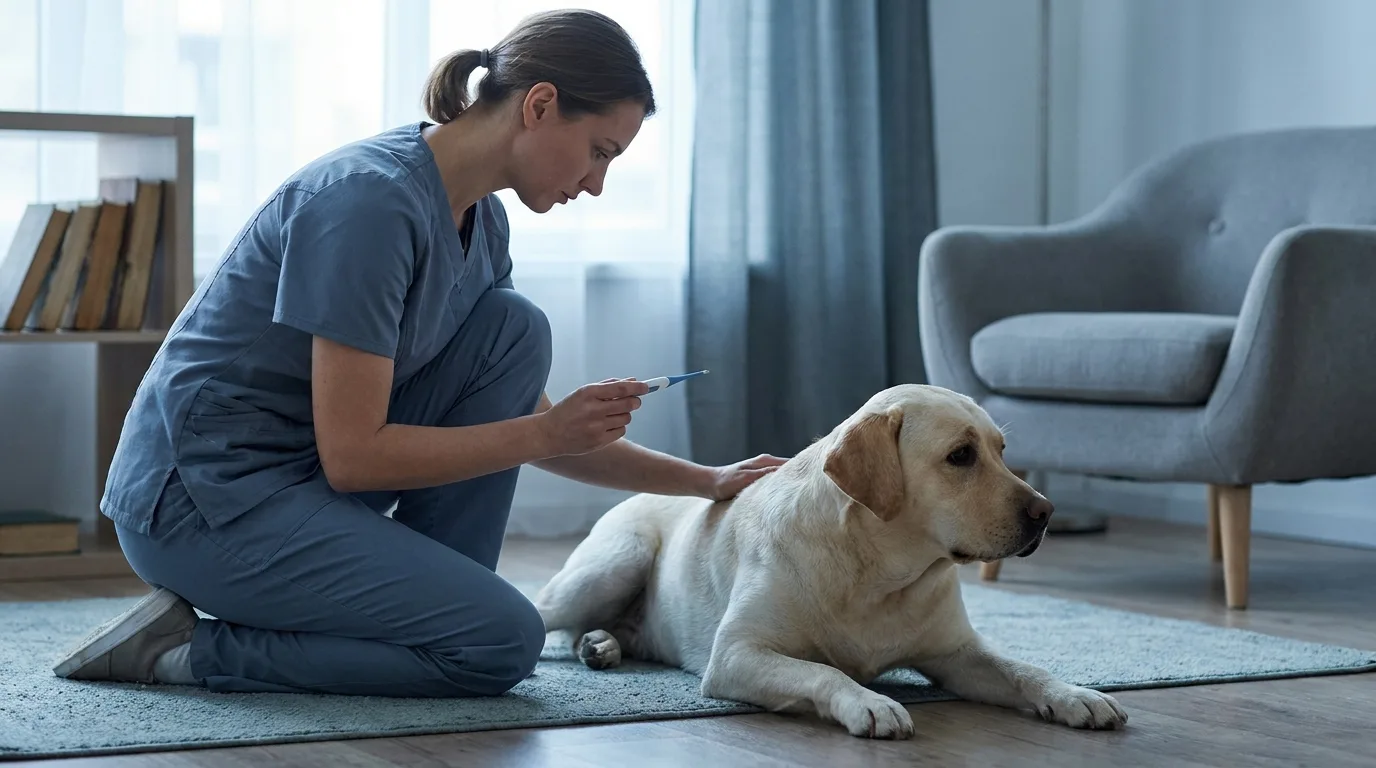
The short answer
- Rectal measurement with a lubricated digital thermometer is the home method that agrees with clinical readings. Everything else trades accuracy for convenience.
- A resting adult dog sits at roughly 37.5–39.2 °C. Wait for the thermometer to stabilise rather than for the first beep on a fast-read device.
- Excitement, exercise, a car journey and a warm room all raise a reading. Let the dog settle for fifteen to twenty minutes or the number describes the last half hour, not the dog.
- A low temperature in a puppy, a small dog or a collapsed animal is the more urgent finding, not the reassuring one.
- The reading is worth far more against that dog's own resting baseline, which costs nothing to record while it is well.
“What is his temperature?” is the first question a veterinary practice asks on the phone, and it is one of the very few clinical measurements an owner can take without equipment or training. It is also easy to take in a way that produces a number nobody can use.
Everything below is about getting a reading you could repeat tomorrow under the same conditions, because a single figure with no context answers much less than people expect.
What you need
A digital thermometer kept for the dog and nothing else, a water-based lubricant, and a second person if the dog is larger than a lap. Rigid-tip and flexible-tip designs both work; a flexible tip is more comfortable and more forgiving of a dog that moves.
Do not use a glass mercury thermometer. Human medicine withdrew them for the obvious reason, and the reason applies with more force to an animal that may move suddenly with the device inserted.
The method
- Let the dog settle. Fifteen to twenty minutes after any walk, car journey, play or visitor. A reading taken on an excited dog measures the excitement.
- Prepare the thermometer. Switch it on, wait for the ready signal, and coat the tip generously with a water-based lubricant. Petroleum jelly works if that is what is available.
- Position the dog. Standing or lying on its side, with a second person supporting the chest and talking to it. Most dogs tolerate this better standing.
- Insert gently and angle the tip. Lift the tail at its base. About a centimetre in a small dog, two to three in a large one. Angle the tip so it contacts the wall of the rectum, rather than sitting free in the middle or pressing into faeces — this is the single most common reason a home reading comes out too low.
- Wait for stability, not for the first beep. Fast-read devices beep early and then continue to climb. If yours displays a rising figure, wait until it stops changing.
- Read, then record. The number, the time, and what the dog had been doing.
- Clean and disinfect the thermometer, and label it so it never rejoins the household ones.
Stop if the dog objects seriously. A dog that tenses, growls or turns is telling you something, and a bitten hand plus a dog that now dreads being approached from behind is a worse outcome than an unmeasured temperature. Say on the phone that you could not take it; that is useful information too.
Which method, and what each one is really doing
Reading the number
A resting adult dog sits at roughly 37.5–39.2 °C. The full set of species ranges, and the reasons published intervals differ between reference works, are in normal temperature, pulse and respiratory rate by species.
Two things make that band less useful than it looks. It is wide — nearly two degrees — so a dog can move a long way from its own normal while staying inside it. And it is a population range, which means it describes dogs in general rather than this dog.
Hence the recommendation that costs nothing and pays repeatedly: take the temperature two or three times while the dog is well, at a similar time of day, and write it down. A dog whose ordinary resting reading is 38.1 °C and who now reads 39.1 °C has moved a full degree while remaining “normal”, and that is exactly the information a veterinarian wants.
| Influence | Direction | What to do about it |
|---|---|---|
| Exercise, play, excitement | Raises | Wait 15–20 minutes of genuine rest |
| Car journey, veterinary waiting room | Raises | Expect a higher reading; note it as such |
| Warm room, direct sun, thick coat | Raises | Measure somewhere cool and shaded |
| Time of day | Higher late afternoon | Compare readings taken at a similar hour |
| Oestrus, late pregnancy | Shifts | Baseline changes; a fall before whelping is expected |
| Tip in faeces or free in the lumen | Reads low | Re-angle against the rectal wall and repeat |
A low reading is not the good news it sounds like. Hypothermia in a puppy, a small or thin dog, or any dog that is collapsed, weak or in the late stage of an illness indicates a body that has stopped maintaining itself, and it is a reason to seek help immediately rather than to keep observing. Warming such a dog on the way is reasonable; deciding it must be fine because the number was not high is not.
What to do with the result
If the reading sits outside the band, or has moved substantially from that dog’s baseline, telephone a practice and give them the whole picture rather than the number alone: the value, the time, the method, what the dog had been doing beforehand, and what else you have noticed — appetite, drinking, breathing at rest, faeces, urine, energy. Those are the observations set out in early signs of illness in cats and dogs, and together they are worth far more than a temperature on its own.
Two things not to do while waiting. Do not give anything from a human medicine cabinet to bring a fever down — the reasons run through can I give my dog human painkillers, and paracetamol in particular is a liver problem in dogs. And do not cool a hot dog with ice or ice water: rapid surface cooling constricts skin vessels and can slow heat loss from the core, which is the opposite of the intention. Cool water, shade, air movement and a journey to a practice are the right combination.
Finally, remember what a normal reading does and does not establish. Fever is one sign among many, and plenty of serious problems — obstruction, pain, poisoning, kidney disease — produce a perfectly ordinary temperature. An animal that is clearly unwell with a normal temperature is still clearly unwell.
Bottom line
Take a dog’s temperature rectally with a lubricated digital thermometer kept for that purpose, with the tip angled against the wall rather than sitting free, and wait for the reading to stabilise rather than for the first beep. A resting adult dog sits at about 37.5–39.2 °C, but that band is wide enough that the dog’s own recorded baseline is the more useful comparison. Let the dog settle for fifteen to twenty minutes first, because exercise, excitement, a car journey and a warm room all add tenths of a degree. Ear and infrared devices are for following a trend, not for deciding whether there is a fever. A low reading in a puppy, a small dog or a collapsed animal is more urgent than a high one — and a normal temperature never overrules an animal that is obviously unwell.
Questions readers ask
How do I take a dog's temperature at home?
Use a digital thermometer kept for the dog and nothing else. Coat the tip with a water-based lubricant, have someone steady the dog standing or lying on its side, lift the tail and insert the tip gently about a centimetre in a small dog and up to two or three in a large one, angling it so it rests against the wall of the rectum rather than sitting in the middle. Hold it there until the reading stabilises, then read, clean and disinfect it. If the dog objects strongly, stop — a bitten hand or a frightened dog is worse than a missing number.
What is a normal temperature for a dog?
A resting adult dog is usually between about 37.5 and 39.2 °C measured rectally. Puppies run at or above the top of that band. Because the range is wide, the more informative comparison is against that individual's own resting reading, taken on an ordinary day when nothing was wrong — which is why it is worth recording two or three times while the dog is well.
Are ear or non-contact thermometers accurate enough?
They are convenient and they disagree with rectal readings often enough to change a decision. The canine ear canal is L-shaped, so an aural thermometer has to be positioned correctly to see the eardrum, and ear wax, inflammation and hair all interfere. Non-contact infrared devices measure surface temperature and are affected by coat, ambient conditions, sunlight and distance. Both are usable for tracking a trend in an animal you cannot restrain; neither should settle a question about whether a dog has a fever.
What raises a reading for reasons other than illness?
Exercise, excitement, restraint, a car journey, a warm room, direct sun, panting from stress rather than heat, oestrus and late pregnancy. Any of these can add several tenths of a degree. Let a dog settle for fifteen to twenty minutes before measuring, take the reading before handling rather than after it, and write down what the dog had been doing — a comparison between readings only means something if the conditions match.
When does the number mean I should call?
Above or below the normal band, or a marked change from that dog's own baseline, in either direction. A low temperature matters at least as much as a high one, particularly in a puppy, a small or thin dog, or any dog that is collapsed, weak or in the late stage of an illness — that indicates a body no longer maintaining itself. Also call regardless of the number if the dog is behaving abnormally: an animal that is clearly unwell with a normal temperature is still clearly unwell.
Can I use a mercury thermometer or take it under the leg?
Do not use a glass mercury thermometer — breakage inside or against an animal is a serious problem and these have been withdrawn from human use for the same reason. An axillary reading, taken under the foreleg, systematically underestimates and varies with how well the leg is held against the chest; it is a rough fallback and not a measurement to act on.
Sources
- Normal rectal temperature ranges — MSD/Merck Veterinary Manual
- Dog owners — veterinary manual — MSD/Merck Veterinary Manual
- The Merck Veterinary Manual — MSD/Merck Veterinary Manual
- Pet first aid tips — American Veterinary Medical Association (AVMA)
- Dog welfare advice — RSPCA
Galen publishes reference material on veterinary medicines. It describes how products are labelled, stored and classified; it does not tell you what to give an animal, in what amount, or for how long. Those decisions belong to a veterinarian who has examined the animal, working from the manufacturer's labelling for the exact product in front of them. Where national rules apply — to prescribing, residues in food, or reporting a suspected reaction — the authority in your own country is the one that governs.